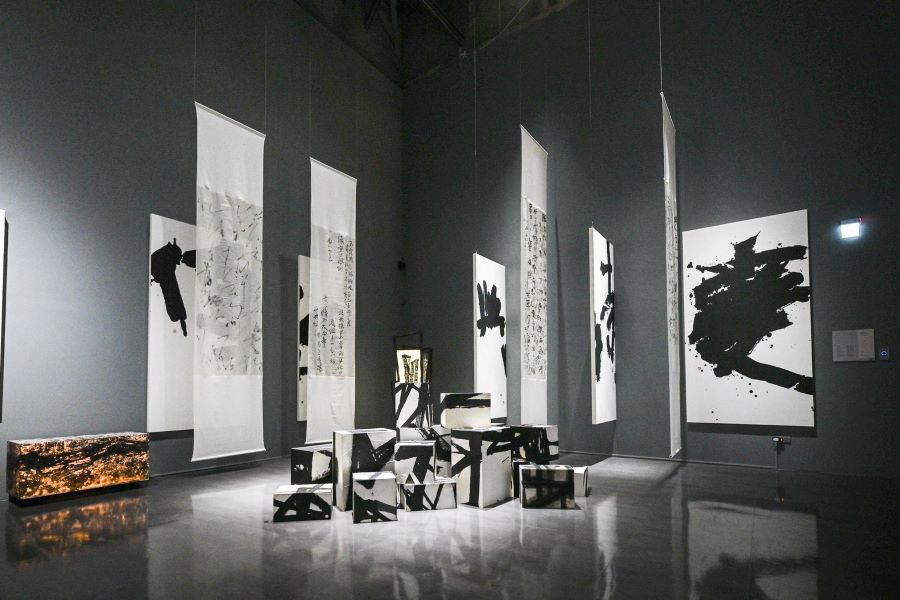
To explore diverse perspectives in the development of modern and contemporary calligraphy, the Taoyuan Museum of Fine Arts (TMoFA) presents Walking Their Own Paths: Women Calligraphers in Contemporary Taiwan, a landmark exhibition centered on Taiwanese women calligraphers across the past century. It also incorporates comparative perspectives from international female artists. Curated by Professor Hui-wen Lu of the Graduate Institute of Art History at National Taiwan University, the exhibition will be on view from September 5 to December 1, 2025 at the Hengshan Calligraphy Art Center (HCAC). Featuring 59 artists and 62 works or installations, the exhibition opens a new gendered dimension in the world of calligraphy by presenting it through the lens of women’s experiences.
Reclaiming Women’s Presence and Writing a Century of History
Chinese calligraphy boasts a rich and enduring tradition with numerous masters and well-established stylistic lineages. However, a closer look at the history and development of East Asian calligraphy reveals that the contributions of women have rarely been spotlighted. Recognizing this gap in Taiwan’s calligraphic history, TMoFA organized the “Unfamiliar Voices: 2020 Women Calligraphy Art Forum” during the preparatory phase of HCAC, focusing on research, practice, and pedagogy in Taiwanese women’s calligraphy. Building on that foundation, Professor Lu conducted two years of fieldwork and interviews with women calligraphers in Taiwan, which became the basis for curating this thematic exhibition.
The exhibition spans a full century of women’s participation in Taiwanese calligraphy, from the Japanese colonial era—with figures such as Cai Bi-Yin, Chang Li Der-Her, and Huang Bau-Ju, renowned for their poetry and literary calligraphy—to post-1949 émigré artists like Chang Mo-Chun, Tan Shu, Gu Ruei-Hua, and Feng Ji-Rong, who had already achieved prominence in China before continuing their practice in Taiwan. Contemporary creators actively shaping the present landscape are also prominently featured. Rather than merely presenting a historical review, the exhibition emphasizes each artist’s role within the shifting social contexts of her time and how calligraphy served as a medium through which these women defined themselves and narrated their lived experiences.
Four Curatorial Themes: A Cross-Disciplinary Vision of Women’s Calligraphy
The exhibition is organized around four major thematic sections that reflect the unique trajectories of women’s calligraphy in Taiwan:
- Networks and Lineages
This section traces the networks and genealogies of women’s calligraphy development, examining family traditions, mentorships, and community affiliations. It highlights how women artists established connections and gained visibility despite institutional limitations. One notable highlight is a collaborative piece by ten members of the Taiwan Women Calligraphers Association, combining various scripts, seal carving, and rubbings to create a complex multi-layered ink composition. This work reflects the intergenerational aesthetics and reinterpretations within women’s calligraphic practice. - Her Body
Focusing on the sensory and corporeal dimensions of writing, this section showcases how the movement of brush and ink embodies will, experience, and perception. One of the exhibition’s highlights is Japanese artist Kawao Tomoko’s HITOMOJI PROJECT—Women series. In this project, five Taiwanese women inscribe characters through bodily poses, merging calligraphy, photography, and video to capture their resilient gestures as they face life’s challenges. - Crossing Boundaries
This section explores how women artists engage in cross-media dialogues, merging calligraphy with photography, video, and installation to transcend traditional forms and contexts. The Chung Hwa Han Guang Calligraphy Association presents an installation titled Transmission, Legacy, and the Flux of Time, integrating abstract ink blocks, layered fabrics, and lighting to construct a dynamic interplay of shadows and strokes—showcasing the collaborative and co-creative power of female calligraphic communities. - Writing Here and Now
This concluding section considers how contemporary women respond to political shifts, gender issues, daily rhythms, and emotional experiences through calligraphy. It also explores poetic collisions between classical texts and modern vocabularies, questioning the contemporary significance of brush and ink as expressive tools.
A Global and Gendered Perspective on Contemporary Calligraphy
Curator Professor Hui-wen Lu notes that this exhibition—through the assembly of 59 artists and 62 works—aims to bring visibility to women calligraphers who have long been overlooked despite their continual creative efforts. It examines how these artists have learned and created within traditional frameworks, how they have been documented and evaluated, and how they have carved out their own artistic spaces.
The exhibition also invites participation from female artists in Europe and East Asia, with works that incorporate brush writing and local materials, as well as Islamic calligraphy by women artists. These transnational references expand the expressive scope of women’s calligraphy across diverse cultural contexts and thematic concerns.
TMoFA hopes that this exhibition will not only broaden gendered narratives in the development of calligraphy but also open up new paths for how women write themselves and their era into being.


