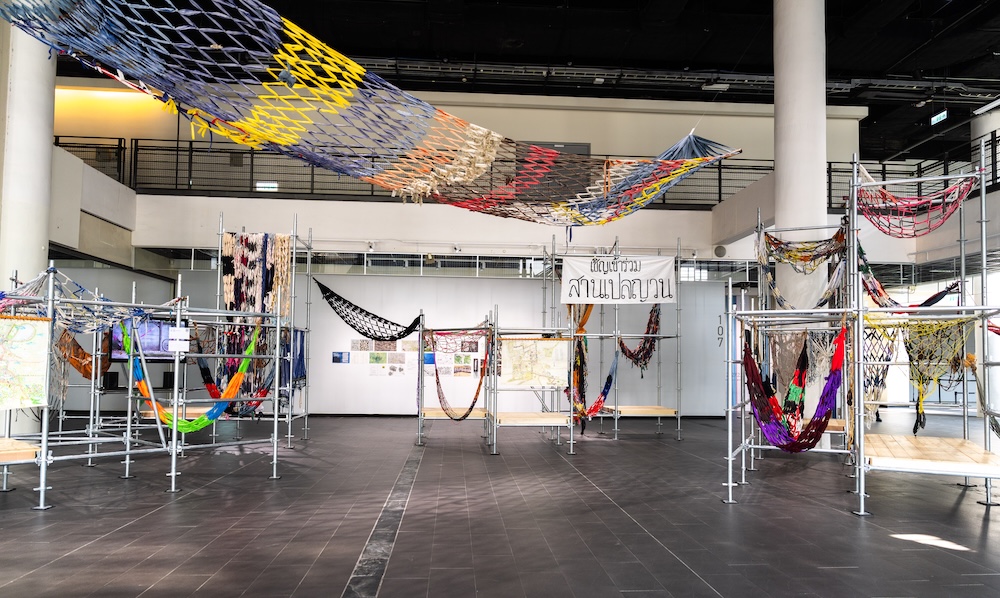
TAICHUNG, Taiwan – The National Taiwan Museum of Fine Arts (NTMoFA) will open the 10th edition of the Asian Art Biennial on 7 November 2026, running through 28 February 2027. Titled “Mrahul Tminun・共織・Co-Weaving,” this year’s edition is curated by LU Pei-Yi, professor at National Taipei University of Education. It presents works by 30 artists and collectives from Asia and around the world, alongside 7 Co-Learning Projects, exploring how cultural diversity and contemporary communities might be connected.
Founded in 2007, the Asian Art Biennial has become one of the region’s most prominent contemporary art events. The 10th edition invites artists from diverse cultural, spiritual, and intellectual backgrounds to respond to pressing contemporary issues.
“This tenth edition is a special milestone for the Asian Art Biennial,” said CHEN Kuang-Yi, Director of NTMoFA. “The Biennial is not merely a static exhibition, but a platform that sparks cross-cultural dialogue and the exchange of ideas. We invite everyone to look forward to the exhibition and its rich programming.”
A Curatorial Approach Rooted in Indigenous Practice
The biennial takes its title from “Mrahul Tminun,” a Truku phrase evoking the everyday practice of Indigenous women gathering to weave and exchange life experiences.
The idea took shape during the COVID-19 pandemic, when curator LU Pei-Yi visited Indigenous communities across Taiwan. “These visits deepened my appreciation of Taiwan’s cultural diversity, and of the island as a node connecting different places and perspectives,” said LU. “They led me to see Asia as a relational field, woven from many different communities.”
Approaching “curating as weaving,” LU brings artists and communities together to foreground the perspectives of women, Indigenous peoples, and queer communities. “Through the exhibition, Co-Learning Projects, and forum, we hope to encourage cross-regional connections and knowledge production, turning the venue into a platform for ‘Woven Knowledge,’” she said.
Artist Highlights
Participating artists’ practices and life trajectories span Taiwan, Malaysia, Indonesia, India, Vietnam, United Kingdom, and Australia, among other places. Many works are the result of years of sustained community engagement or multi-person collaboration, reflecting deep translocal exchange across regions.
- Founded in 2017 in Yogyakarta, Indonesia, GEGERBOYO works across murals, wayang, painting, batik, and installation. Commissioned for this Biennial, its new work Holopis Kuntul Baris: Resources, Propaganda, War, and Exile starts from “gotong royong,” the Indonesian ideal of mutual cooperation, and asks how colonial and Japanese-occupation authorities turned communal labour into tools of surveillance and propaganda. Built around a Javanese countryside site treated as a “monument of trauma,” the installation explores where nationalism, faith, and unresolved violence intersect, and who is allowed to stay or forced into exile.
- Taiwanese artist and researcher HOU I-Ting examines women’s labour, body politics, and history through fieldwork. Her long-term series Sewing Fields draws on archival photographs of women workers to recover the skill behind consumer culture, and invites the public to embroider. The Biennial presents Needlewomen in the Fields——When Needles Spark, which combines embroidery with digital images and draws on archival photographs from the collections of different museums and cultural institutions for public embroidery sessions, alongside new works including pieces commissioned by CHAT in Hong Kong.
- Artist duo Hylozoic/Desires (Himali Singh SOIN and David Soin TAPPESER), who work between London and New Delhi, combine poetry and music to conjure speculative futures. Hedge of Halomancy excavates the Inland Customs Line, a forgotten 4,000-kilometre border across the Indian subcontinent. Some 2,500 kilometres of it was a planted barrier, the Great Hedge of India, built by the East India Company in the 19th century to enforce its salt monopoly. The work recasts the hedge as both slow violence and a garden of resistance. I and Thou, made from photographs of India’s salt pans, explores the agency of salt.
- Artist-run collective Open Contemporary Art Center (OCAC) has been fostering artistic exchanges between Taiwan and Southeast Asia since its founding in 2001. With Hanoi-based Nhà Sàn Collective, it presents Meander Maps, a Taiwan–Vietnam project born from residencies begun in 2023, in which twelve groups of artists take the Red River as a metaphor for cross-cultural exchange. Its latest iteration, Meander Maps: The Salvaged that Continue to Speak, uses notes, sound, scent, and images to recover what the journey left behind.
- Malaysian artist YEE I-Lann uses photomedia and digital collage to examine colonialism and power in Southeast Asia. Since returning to her hometown in 2017, she has worked with Indigenous communities. TIKAR/MEJA/PLASTIK, made with female weavers of the Bajau Sama Dilaut community on Omadal Island, features sixty woven mats (tikar), symbols of egalitarian connection, patterned with tables (meja) that represent colonial, patriarchal, and state authority. When rolled up, the mats trap the tables inside, symbolically dismantling top-down power in what Yee calls “histories from below.”
Opening Weekend Program Highlights
The Biennial opens with two days of performances, talks, and participatory events:
- 7 & 8 Nov, 10:30–17:30: 2026 Asian Art Forum, themed “Co-Weaving Asia: Collectivity, Community, and the Politics of the Common”
- 7 Nov, 14:00: OCAC, Meander Maps: A(s) Performance
- 7 Nov, 16:30: Labay EYONG, Co-Weaving Action
- 7 Nov, 19:30: HomoPleasure Collective, 酷趴踢QooPa Opening – After Party: The In-Between Bridge
- 8 Nov, 10:00: GUDSKUL, Collective Board Games
- 8 Nov, 14:00: HOU I-Ting, Sewing Field: Public Participation Project
To mark the tenth edition, the Biennial extends the idea of weaving from art and craft into everyday community life through a citywide program Interweave. Cultural venues and brands in Taichung, including Carp Gallery, Glitch, Petitdeer Gallery, Yáo, and ZASSO, will present programs during the Biennial that widen audiences for contemporary art and carry its themes into the wider community.
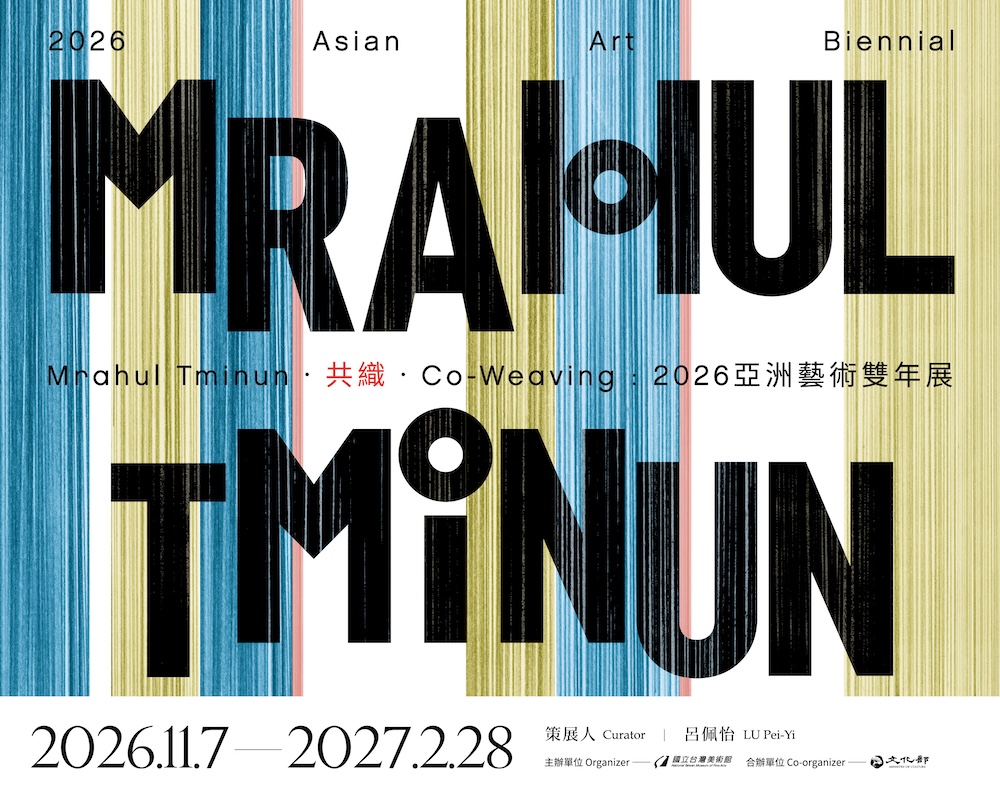
10th Asian Art Biennial
Mrahul Tminun · 共織 · Co-Weaving
- Exhibition Period: 2026.11.7 – 2027.2.28
- Exhibition Venue: National Taiwan Museum of Fine Arts (NTMoFA)
- Curators: LU Pei-Yi
- Participating Artists: Irwan AHMETT & Tita SALINA, Busui AJAW, Mounira AL SOLH, CHANG En-Man, Sheba CHHACHHI & Janet PRICE, Culture Ferment Studio (HUANG Po-Chih, HUANG Chien-Yu, HUANG Wei-Xi, HUANG Zhe-Xi), DAVRA Collective, Cian DAYRIT, Labay EYONG, GEGERBOYO, Helen GRACE & Phaptawan SUWANNAKUDT, Speedy Grandma, GUDSKUL, HomoPleasure Collective, HOU I-Ting, Hylozoic/Desires (Himali Singh SOIN & David Soin TAPPESER), Inter-Asia Woodcut Mapping, Aziza KADYRI, Aluaiy KAUMAKAN, KUO Yu-Ping, LEE Kai Chung & SHEN Jun, Eleng LULUAN, Meita MEILITA, Haji OH, Open Contemporary Art Center (OCAC), Pallavi PAUL, Citra SASMITA, Womanifesto, Yamanaka Suplex, YEE I-Lann
- Co-Learning Programs:
- Co-Learning the Southern Linguistics through Songs and Translation
- Intimate Commons
- The Meandering Games
- Sewing Lives: Stories of Malaysia Garment Factory Women in the 1970s
- Weaving the Commons: Art Archives, Materiality, and the Labour of Keeping
- Weaving Invisible Threads
- Zero Experience — Learning from Plants: Tree Tree Tree Person × Datong Community Co-Learning Intensive


