The Taiwan Pavilion of the 16th Gwangju Biennale, Instance Dungeons: Gray Zone, opened on September 5, 2026 at the National Asian Culture Center (ACC) in Gwangju, South Korea, and will run through November 15. The opening drew a large crowd of directors, curators, artists, and members of the press from arts institutions around the world, all bearing witness to the Taiwan Pavilion’s latest presentation on the international biennial stage.
Director of the National Taiwan Museum of Fine Arts (NTMoFA), CHEN Kuang-Yi, remarked that it was a pleasure to join the opening of the Taiwan Pavilion’s Instance Dungeons: Gray Zone here in Gwangju. “The ‘gray zone’ is not a place where answers are unclear—on the contrary, it is precisely where we must remain sensitive, reflective, and discerning. This is also why art matters: it lets us see details we usually overlook, question the orders we’ve come to take for granted, and bring different experiences together within the same space. Gwangju is a city with a distinct historical memory, one that helps us understand that freedom, dignity, and the right to expression are never abstract concepts, but values that must be put into practice anew in every era. For this reason, it is especially meaningful that the ‘Taiwan Pavilion’ is here today.”
Curator of the Taiwan Pavilion, CHEN Hsiang-Wen, noted that despite some challenges before the opening, the exhibition was able to open successfully thanks to the team’s efforts. Instance Dungeons: Gray Zone brings together nine Taiwanese artists, and the exhibition’s title, she said, was not a last-minute change prompted by recent events, but rather reflects an issue Taiwanese people have long grappled with amid a complex historical and geopolitical context. Through this diverse artistic presentation, she hopes visitors in Gwangju will find their own points of connection and resonate with the exhibition, and she extended special thanks to ACC, the Gwangju Biennale, and all the friends at home and abroad who provided support during the preparation process.
Taiwanese Artists in Gwangju: Confronting the Geopolitical Gaze of the First Island Chain through Archival Deconstruction and Technological Media
Situated in the First Island Chain, Taiwan has long been subjected to the geopolitical gaze as a “gray zone.” Built upon NTMoFA’s recent exhibition Instance Dungeons and Sights, the project Instance Dungeons: Gray Zone delves deeper into Taiwan’s tangled historico-political context and its geostrategic significance amid the global turmoil of the New Cold War structure.
Here, the project metaphorizes the concept of the “instance dungeon,” framing it as an arena where histories and conflicts endlessly recur and intertwine within global power dynamics. The exhibited works directly confront Taiwan’s political narratives and collective memories. Adopting the perspectives of transnational migration and geopolitical maneuvering while deconstructing and reconstituting archives, these works unleash the specters of history that have been suppressed by increasingly polarized ideologies and the Cold War system.
CHENG Hsien-Yu, a past S+T+ARTS Honorary Mention recipient at Ars Electronica (2023), presents Traced, an AI-powered light installation that uses computer vision and real-time motion tracking to have a spotlight follow every individual moving through the space. The piece reconfigures surveillance into a poetic act of “witnessing,” while asking whether outsourcing our agency to automated systems is silently eroding our sense of morality and empathy.
JUAN Po-Yuan presents two new works. Searching for the Nose Beneath Fronta na maso feeds the historical archives and urban legends of the underground space beneath Prague’s former Stalin monument into an AI, exposing the “aphasia” and “failure” that emerge when algorithmic logic tries to fill the voids of historical trauma. Grinding_tw feeds archives of Taiwan’s Cold War military ruins into a generative image AI; when the AI misreads these ruins as first-person-shooter game scenes, Taiwan’s military bases become a self-generating instance dungeon with no exit.
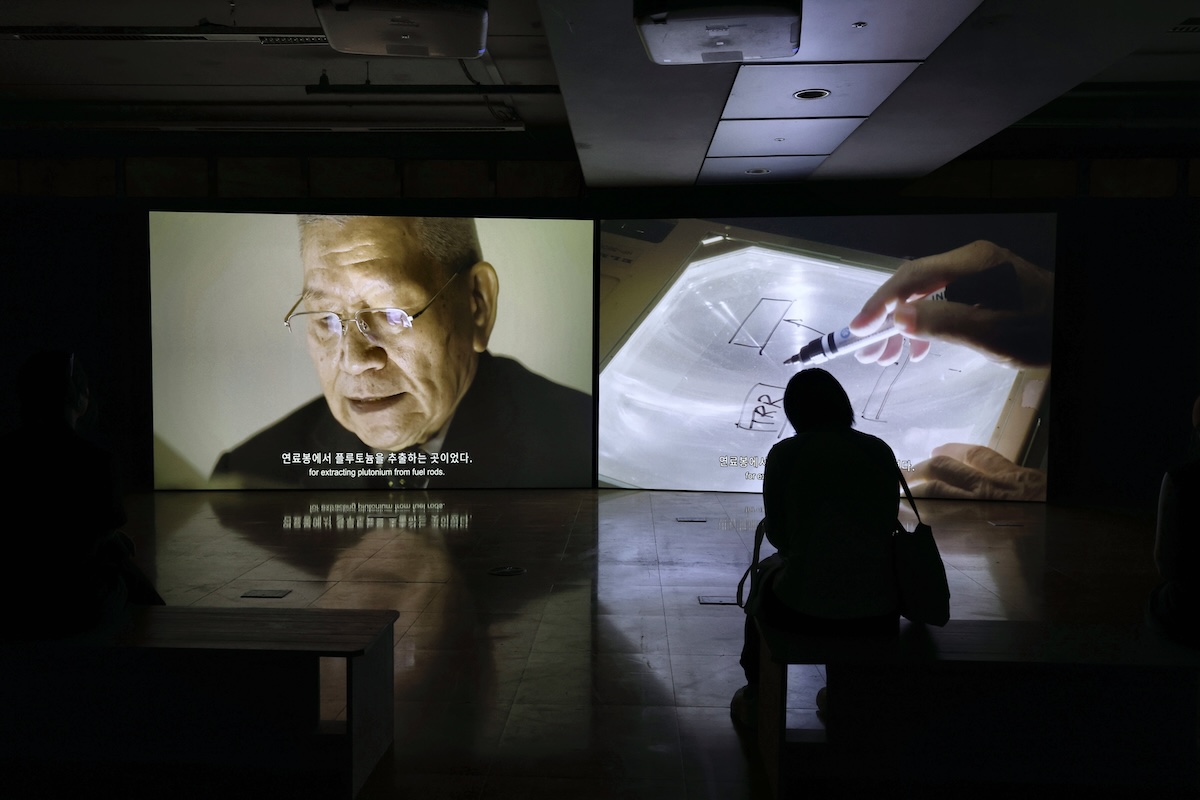
HSU Che-Yu & CHEN Wan-Yin, long-term collaborators since 2015, present the video work House a, centered on Taiwan’s former “Plutonium Separation Plant.” The artists invited a scientist once involved in the nuclear weapons program, along with cultural activists and theater performers, to re-enact the spatial techniques of sequestration and burial at the nearby Sa’wac (Kanjin) Amis community—building and dismantling a “house within a house” to reveal the otherwise inaccessible core of the entombed facility.
SU Hui-Yu, a past selectee of the Forum section at the Berlin International Film Festival (2025), presents The Space Warriors and the Digigrave, continuing his signature “Re-Shooting” methodology by revisiting a 1980s Taiwanese sci-fi series from the martial law era. Su transforms the imagery of Chiang Kai-shek Memorial Hall into an AI-generated “Digigrave” spaceship, questioning grand narratives while its technical complexity mirrors Taiwan’s role in today’s AI supply chain.
LI Yi-Fan, who recently represented Taiwan at the 2026 Venice Biennale, presents his 2019 piece important_message.mp4, taking internet conspiracy theories as a starting point to ask: information may not always be true, but might the fear and desire it provokes be false as well? The work probes how we distinguish the real from the illusory amid explosive information intake.
LIN Yu-Liang’s Nothing But a Faint Shadow builds around “shadow” and “map” to address how perception is constructed by technology and systems. A shadow’s asymmetry and susceptibility to misreading suggest that the landscapes we walk through have already been targeted and anchored by systems; the shadow becomes the route, and we merely follow.
Ting-Ting CHENG’s Audio Description presents three similar yet subtly different segments of the artist interviewing a war correspondent. Viewers gradually discover the interviewee is a performer re-enacting the conversation—raising questions about the framing and authenticity of news imagery, and unsettling the trust between media and audience.
CHANG Wen-Hsuan’s Data Exceeds the Limit explores information overload in the digital age and in wartime, juxtaposing two Korean War-era sites of “information overload”: Green Island, a White Terror-period prison in Taiwan, and Busan, the temporary wartime capital. A two-channel video of fragmented first-person narratives reveals the damage such overload inflicts on memory and daily life. Commissioned for the 2024 Busan Biennale, the work is part of the artist’s ongoing project File:\new-order.
This edition of the Gwangju Biennale takes as its theme You Must Change Your Life, exploring the transformative power of art in responding to the multiple crises and urgencies of our time. Within Instance Dungeons: Gray Zone, Taiwanese artists’ probing inquiries into surveillance technology, historical memory, geopolitics, and information warfare are themselves rooted in Taiwan’s lived experience within a geopolitical gray zone—and the difficulties the Taiwan Pavilion’s name encountered during preparation only affirmed the necessity of these creative perspectives. That the Pavilion was ultimately able to participate under the name “Taiwan Pavilion” not only resonates with this edition’s core spirit, but also stands as a concrete demonstration of Taiwan’s artistic energy on the international stage.
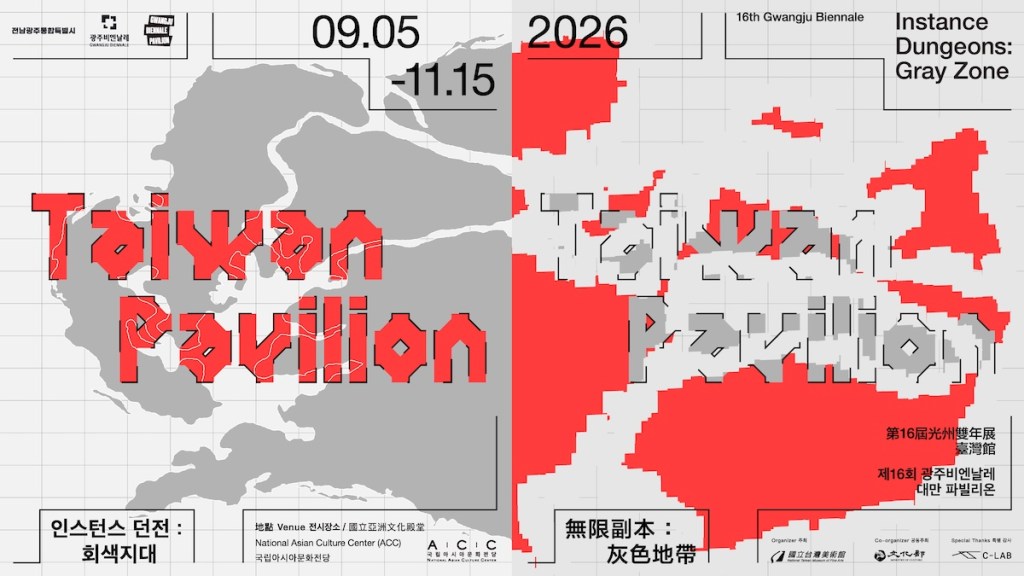
16th Gwangju Biennale Taiwan Pavilion
Instance Dungeons: Gray Zone
- Exhibition Period: 2026.09.05 – 11.15
- Exhibition Venue: National Asian Culture Center (ACC)
- Curators: CHEN Hsiang-Wen, LIN Hsiao-Yu
- Participating Artists: CHENG Hsien-Yu, JUAN Po-Yuan, HSU Che-Yu & CHEN Wan-Yin, SU Hui-Yu, LI Yi-Fan, LIN Yu-Liang, Ting-Ting CHENG, CHANG Wen-Hsuan
- Organizer: National Taiwan Museum of Fine Arts (NTMoFA)
Co-organizer: Ministry of Culture, Taiwan
Special Thanks: Taiwan Contemporary Culture Lab (C-Lab)
Sponsor: NTMoFA Patrons Circle


